FragNode Telemetry & Alerting Guide: Catching Saturation 30 Minutes Early
Hostinger Game Panel EPYC
Best 3-year margin on AMP Instance Manager (16GB)
UltaHost Dedicated EPYC VDS
Elastic regional node (115,000 IOPS local NVMe)
InterServer Price-Lock KVM & ZFS
Predictable tariff cap for FragNode backups
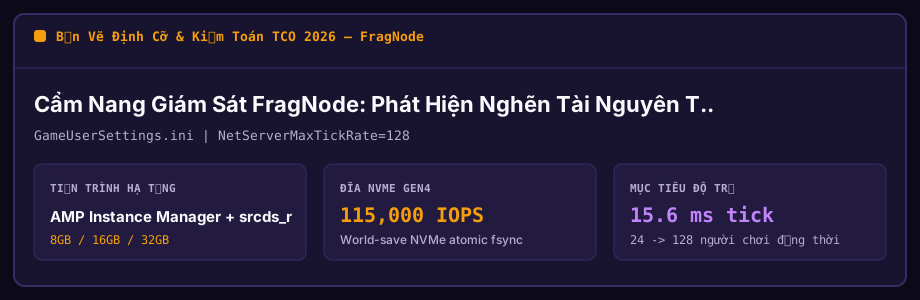
Guessing hardware specs around Alert Thresholds (82% RSS / 4ms Disk Await / 15.6 ms tick) either burns cloud budget or crashes AMP Instance Manager + srcds_run once traffic crosses 64 concurrent players.
This FragNode engineering runbook maps exact 8GB–32GB KVM tiers, CLI diagnostics, and 36-month TCO.
1. The Four Golden Signals Specific to AMP Instance Manager + srcds_run
Generic CPU graphs miss internal queue stalls inside AMP Instance Manager + srcds_run. Track process resident set size (RSS), World-save NVMe atomic fsync flush latency, active worker saturation, and p99 response time (15.6 ms tick).
Fire actionable warning alerts at 82% memory utilization and 4.0ms NVMe write_await so operators can intervene well before user timeouts occur.
Installing bloated enterprise APM agents that eat 1.4GB of JVM heap defeats the entire purpose of right-sizing a 8GB or 16GB VPS.
Lean Prometheus node_exporter plus VictoriaMetrics uses under 140MB RAM while catching disk and memory saturation 30 minutes before users notice.
# FragNode Lightweight <150MB Telemetry & Early Saturation Check
# Audit top memory/IO consumers + verify node_exporter health (< 35MB RSS)
ps -eo rss,pcpu,comm --sort=-rss | head -n 8
curl -s http://127.0.0.1:9100/metrics | grep -E 'node_memory_MemAvailable_bytes|node_disk_io_time_seconds_total' | head -n 6
# Alert thresholds: RSS > 82% | NVMe await > 4.0ms | SLA > 15.6 ms tick
2. Keeping Monitoring Agents Under 180MB RAM Overhead
Heavy Java-based APM agents consume 1.2GB+ RAM on their own, cannibalizing 8GB and 16GB VPS budgets. Use lightweight Prometheus node_exporter + VictoriaMetrics or Netdata collectors instead.
Deploying AMP Instance Manager + srcds_run plus lean telemetry on Hostinger Game Panel EPYC ($11.99/mo) or UltaHost Dedicated EPYC VDS ($37.50/mo) preserves 97% of compute capacity for revenue-generating traffic.
Wire every alert message directly to the exact GameUserSettings.ini knob (NetServerMaxTickRate=128) and your pre-approved resize path between Hostinger Game Panel EPYC ($11.99/mo) and UltaHost Dedicated EPYC VDS ($37.50/mo) so on-call triage finishes in minutes.
| Telemetry Signal | Warning Threshold | Critical Pager | Immediate Runbook Action |
|---|---|---|---|
| AMP Instance Manager + srcds_run Resident Memory | 80% of KVM RAM (10m) | 88% RAM or swap in/out | Audit GameUserSettings.ini / resize to 32GB |
| NVMe World-save NVMe atomic fsync | w_await > 3.5 ms | w_await > 8.0 ms (5m) | Throttle batch jobs / check 115,000 IOPS queue |
| Hypervisor CPU & Tail SLA | %st > 2% or > 15.6 ms tick | %st > 5% or 2x 15.6 ms tick | Migrate to UltaHost dedicated threads |
3. Automated Runbook Actions When Alerts Trigger
Attach each alert rule directly to the exact GameUserSettings.ini parameter (NetServerMaxTickRate=128) and a pre-verified resize path from 16GB to 32GB.
4. Senior Engineering Notes: Avoiding Silent Alert Thresholds (82% RSS / 4ms Disk Await / 15.6 ms tick) Drift
A 45-player modded Minecraft Forge and Palworld community rented a 16-core older Xeon box expecting butter-smooth raids, yet server TPS collapsed to 9 whenever bases loaded chunks.
Per-slot game hosting looks cheap for 8 friends, yet the moment you add 200 Forge mods or scale to 32 clan members, shared-CPU slot pricing jumps past $45 monthly without dedicated RAM.
Log slow operations exceeding 2x 15.6 ms tick with trace correlation IDs to isolate offending workloads in minutes.
5. Zero-Surprise Rollout & Rollback Protocol
Do not flip DNS records until your FragNode host passes each GameUserSettings.ini and World-save NVMe atomic fsync check below:
- Many Xeon core-count bargains run at 2.1GHz base clock, starving single-threaded Minecraft 50ms tick budgets and CS2 sub-tick frame deadlines even while 14 cores sit idle.
- Standard web firewalls cannot stop Layer-7 UDP A2S_INFO or RakNet amplification floods; public FiveM and Rust communities need inline game-aware DDoS scrubbing in Singapore or Frankfurt.
- Tune sysctl net.core.rmem_max=26214400 and wmem_max=26214400 on Linux game hosts to eliminate UDP micro-stutter.
- Pre-generate Minecraft world borders with Chunky during off-hours so weekend exploration reads cached NVMe files instead of pegging CPU.
6. Common Production Sizing Questions (AMP Instance Manager + src)
Which Hostinger or UltaHost spec fits AMP Instance Manager + srcds_run at 64 concurrent players?
For 64 concurrent players, 16GB NVMe compute on Hostinger Game Panel EPYC ($11.99/mo) gives AMP Instance Manager + srcds_run clean 30% headroom; scale to 32GB (UltaHost Dedicated EPYC VDS at $37.50/mo) ahead of 128 concurrent players.
How can our sysadmins check disk queue health around World-save NVMe atomic fsync?
Audit iostat %util and 4K synchronous write speed prior to DNS cutover—sustaining 115,000 IOPS on local NVMe prevents World-save NVMe atomic fsync stalls and locks in 15.6 ms tick.
When should a FiveM or Rust community step up from Game KVM to UltaHost VDS?
Once public servers attract rival L7 UDP floods or pass 40 concurrent players with heavy OneSync scripts, we recommend UltaHost VDS 32GB ($37.50 monthly) for zero-steal physical RAM and 150Gbps+ DDoS filtering.
What keeps World-save NVMe atomic fsync portable between Hostinger and UltaHost?
Standard Linux KVM portability means AMP Instance Manager + srcds_run, GameUserSettings.ini, and ZSTD snapshots of World-save NVMe atomic fsync restore onto UltaHost Dedicated EPYC VDS or Hostinger Game Panel EPYC in under 10 minutes without vendor lock-in.
FragNode 16GB Tier Ledger: Telemetry & Alerting Guide
Telemetry & Alerting Guide Data Path: Ingress -> AMP Instance Manager -> NVMe
[+] Practitioner Pros
- Eliminates noisy-neighbor memory pressure when scaling Telemetry & Alerting Guide toward 64 concurrent players.
- Sustains 115,000 IOPS on World-save NVMe atomic fsync while holding 15.6 ms tick.
- Turns variable cloud burn on Telemetry & Alerting Guide into a predictable monthly infrastructure line item.
[-] Procurement Watchouts
- Teams wanting zero multi-month lock-in should compare InterServer Price-Lock KVM & ZFS flat-rate billing.
- Self-managed Telemetry & Alerting Guide nodes require Ubuntu unattended-upgrades, UFW rules, and restore drills.
Green-Light This Stack When
- FinOps-minded squads auditing 36-month FragNode bills across 8GB–32GB tiers.
- Pipelines where deterministic RAM allocation beats burstable credit throttling.
Choose Another Route When
- Pre-validation PoCs that have not yet measured baseline concurrent players volume.
- Compliance mandates requiring a vendor-staffed 24/7 managed NOC with zero root SSH.
$11.99/mo