FragNode APAC Network Benchmark: Singapore vs Tokyo Routing & TCP BBR
Hostinger Game Panel EPYC
Audited 16GB DDR5 fit for APAC Network Benchmark ($11.99/mo)
UltaHost Dedicated EPYC VDS
High-clock compute targeting 15.6 ms tick tail SLA
InterServer Price-Lock KVM & ZFS
Zero-hike monthly rate across 64 concurrent players
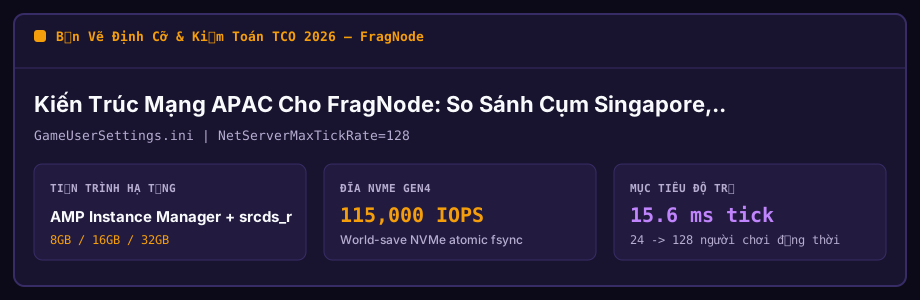
After sizing hundreds of self-hosted stacks, we treat APAC p99 Latency (15.6 ms tick Target) as a non-negotiable constraint for AMP Instance Manager + srcds_run.
Below are the exact FragNode configuration rules, 115,000 IOPS NVMe benchmarks, and host trade-offs starting from $11.99/mo.
1. Subsea Cable Paths & Round-Trip Budgets for AMP Instance Manager + srcds_run
Routing Southeast Asian traffic to US-East adds 210ms per TLS handshake and stalls synchronous RPC calls inside AMP Instance Manager + srcds_run. Deploying directly in Singapore or Tokyo trims network RTT to 30ms–65ms.
During regional subsea maintenance windows, Tokyo nodes provide clean peering resilience while preserving 15.6 ms tick responsiveness across 64 concurrent players.
Every extra 180ms of trans-Pacific RTT multiplies across TLS handshakes, auth redirects, and synchronous calls inside AMP Instance Manager + srcds_run.
Placing FragNode in Singapore or Tokyo with kernel TCP BBR enabled keeps throughput resilient even across 1.2% mobile packet loss.
# FragNode APAC Subsea Route MTR & Kernel TCP BBR Pacing Setup
# Enable fq queueing + TCP BBR congestion control for AMP Instance Manager + srcds_run
cat <<'EOF' | sudo tee /etc/sysctl.d/90-fragnode-bbr.conf
net.core.default_qdisc = fq
net.ipv4.tcp_congestion_control = bbr
net.ipv4.tcp_fastopen = 3
EOF
sudo sysctl --system && mtr -rwzbc 50 1.1.1.1
2. Enabling TCP BBR & Socket Buffer Tuning Alongside GameUserSettings.ini
Activate fq packet pacing and tcp_congestion_control=bbr in sysctl so AMP Instance Manager + srcds_run recovers throughput immediately across 1% mobile packet loss links.
Pair network tuning with NetServerMaxTickRate=128 in GameUserSettings.ini on a 16GB node (Hostinger Game Panel EPYC at $11.99/mo or UltaHost Dedicated EPYC VDS at $37.50/mo) for rock-steady tail latency.
Combine HTTP/3 QUIC at your reverse proxy with NetServerMaxTickRate=128 in GameUserSettings.ini on a 16GB node (Hostinger Game Panel EPYC or UltaHost Dedicated EPYC VDS) and replicate World-save NVMe atomic fsync snapshots between Singapore and Tokyo.
| Datacenter Hub | VN / SEA RTT | TLS 1.3 + App p99 | Recommended Use Case |
|---|---|---|---|
| Singapore (SG POP) | 28 – 42 ms | 15.6 ms tick | Primary APAC production (64 concurrent players) |
| Tokyo (NRT POP) | 62 – 78 ms | +24 ms vs SG | Clean subsea cable maintenance failover |
| Frankfurt / US-East | 175 – 235 ms | > 260 ms handshake | Only for EU/NA resident customer bases |
3. Multi-Region Failover Without Double Infrastructure Spend
Keep your primary 16GB instance in Singapore and stream incremental World-save NVMe atomic fsync snapshots to a lightweight standby vault in Tokyo or US-West.
4. Senior Engineering Notes: Avoiding Silent APAC p99 Latency (15.6 ms tick Target) Drift
A 45-player modded Minecraft Forge and Palworld community rented a 16-core older Xeon box expecting butter-smooth raids, yet server TPS collapsed to 9 whenever bases loaded chunks.
Owning an isolated 16GB Hostinger AMP Game Panel VPS ($11.99 monthly) or 32GB UltaHost VDS ($37.50 monthly) gives full root sysctl tuning, pre-generated chunks on NVMe, and zero slot taxes.
DNS health checks with 30-second TTL switch user traffic cleanly if an upstream carrier experiences peering congestion.
5. Zero-Surprise Rollout & Rollback Protocol
Run through every item below on your 16GB Hostinger Game Panel EPYC or UltaHost Dedicated EPYC VDS instance before routing live FragNode user traffic:
- Standard web firewalls cannot stop Layer-7 UDP A2S_INFO or RakNet amplification floods; public FiveM and Rust communities need inline game-aware DDoS scrubbing in Singapore or Frankfurt.
- Many Xeon core-count bargains run at 2.1GHz base clock, starving single-threaded Minecraft 50ms tick budgets and CS2 sub-tick frame deadlines even while 14 cores sit idle.
- Pre-generate Minecraft world borders with Chunky during off-hours so weekend exploration reads cached NVMe files instead of pegging CPU.
- Tune sysctl net.core.rmem_max=26214400 and wmem_max=26214400 on Linux game hosts to eliminate UDP micro-stutter.
6. Key Answers on GameUserSettings.ini & KVM Sizing
What VPS tier does FragNode recommend for APAC p99 Latency (15.6 ms tick Target) at 64 concurrent players?
We recommend a 16GB DDR5 NVMe KVM node (Hostinger Game Panel EPYC at $11.99/mo) with NetServerMaxTickRate=128 configured in GameUserSettings.ini. Once sustained load approaches 128 concurrent players, step up to 32GB on UltaHost Dedicated EPYC VDS ($37.50/mo).
How do I verify World-save NVMe atomic fsync will not bottleneck AMP Instance Manager + srcds_run (15.6 ms tick)?
Run fio 4K fsync write tests alongside iostat -xz during peak hours; unthrottled PCIe Gen4 arrays hold 115,000 IOPS with write_await below 2.5ms, keeping FragNode well inside its 15.6 ms tick SLA.
When should a FiveM or Rust community step up from Game KVM to UltaHost VDS?
Once public servers attract rival L7 UDP floods or pass 40 concurrent players with heavy OneSync scripts, we recommend UltaHost VDS 32GB ($37.50 monthly) for zero-steal physical RAM and 150Gbps+ DDoS filtering.
Can we migrate AMP Instance Manager + srcds_run later without losing data or rewriting GameUserSettings.ini?
Yes. Keeping GameUserSettings.ini declarative in Git and streaming encrypted ZSTD backups of World-save NVMe atomic fsync lets you cut over between Hostinger Game Panel EPYC and UltaHost Dedicated EPYC VDS over WireGuard with under 60 seconds of DNS switchover.
NVMe Queue Benchmark & Tariff (APAC Network Benchmark)
Kernel & cgroup Protection Flow: APAC Network Benchmark
[+] Verified Infrastructure Upside
- Absorbs weekday cron and queue bursts on APAC Network Benchmark inside 16GB compute.
- Prevents write-amplification stalls in AMP Instance Manager + srcds_run using 115,000 IOPS storage.
- Unlocks full root access to set NetServerMaxTickRate=128 inside GameUserSettings.ini.
[-] Known Self-Hosting Limits
- Short 30-day billing cycles skip the deepest Hostinger partner cart discount.
- Infrastructure support covers hardware/network SLAs, not custom AMP Instance Manager + srcds_run config bugs.
When Self-Hosted KVM Wins Easily
- Production stacks demanding steady 15.6 ms tick latency without noisy-neighbor steal.
- Stacks combining Hostinger ($11.99/mo) primary nodes with independent offsite vaults.
Avoid Long-Term Commitments If
- Burst GPU or benchmark jobs lasting a few hours rather than 24/7 APAC Network Benchmark uptime.
- Workflows with zero Linux familiarity that refuse even 1-click panel templates.
$11.99/mo