FragNode Production Hardening Checklist: Zero Exposed Internal Ports
Hostinger Game Panel EPYC
Production Hardening Checklist sweet spot (16GB / 115,000 IOPS) — Game Panel 4 (16GB DDR5 + AMP Panel)
UltaHost Dedicated EPYC VDS
Low-RTT compute for AMP Instance Manager + (15.6 ms tick)
InterServer Price-Lock KVM & ZFS
Flat-rate backup/steady option (24–64 concurrent players)
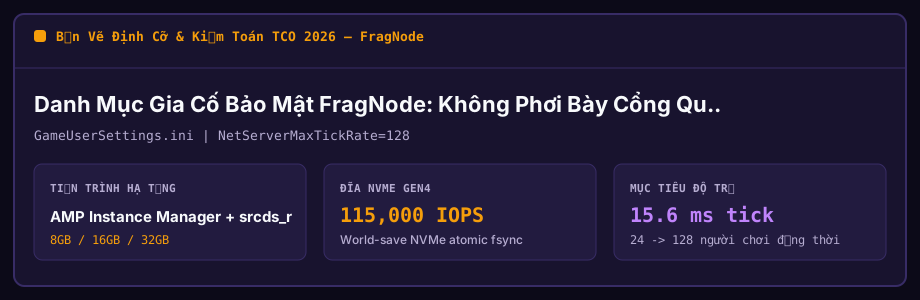
Most AMP Instance Manager + srcds_run slowdowns blamed on application code actually trace back to uncalibrated Attack Surface Reduction (0 Public Admin/DB Sockets) limits and throttled storage queues.
Here is the complete FragNode practitioner blueprint for 24–128 concurrent players.
1. Binding AMP Instance Manager + srcds_run Strictly to Loopback & WireGuard Interfaces
Publishing Docker or daemon ports with 0.0.0.0 bypasses UFW rules by rewriting iptables nat chains directly, exposing internal AMP Instance Manager + srcds_run sockets to internet-wide scanners.
Bind internal listeners explicitly to 127.0.0.1 or your wg0 private subnet inside GameUserSettings.ini, exposing only ports 80 and 443 through a hardened TLS 1.3 reverse proxy.
Publishing container ports with -p 8080:8080 silently rewrites Linux iptables nat chains and bypasses UFW completely, exposing AMP Instance Manager + srcds_run admin endpoints to automated internet scanners within 90 seconds of boot.
# FragNode Loopback Socket Audit, UFW Lockdown & SSH Hardening
# Verify zero internal AMP Instance Manager + srcds_run sockets leak on 0.0.0.0
ss -tulpn | grep -v '127.0.0.1'
sudo ufw default deny incoming && sudo ufw allow 443/tcp && sudo ufw allow in on wg0
sudo sshd -T | grep -E 'passwordauthentication|permitrootlogin|pubkeyauthentication'
2. Ed25519 SSH Keys, CrowdSec Bouncers & DDoS Filtering
Disable PasswordAuthentication in sshd_config and deploy lightweight CrowdSec nftables bouncers consuming under 95MB RAM even on 8GB starter nodes.
Both Hostinger Game Panel EPYC ($11.99/mo) and UltaHost Dedicated EPYC VDS ($37.50/mo) provide upstream volumetric DDoS mitigation so malicious SYN floods never saturate your 64 concurrent players capacity.
Bind internal listeners explicitly to 127.0.0.1:PORT or your wg0 WireGuard interface inside GameUserSettings.ini, run CrowdSec nftables bouncers (< 90MB RAM), and rely on Hostinger Game Panel EPYC / UltaHost Dedicated EPYC VDS upstream DDoS filtering.
| Service Plane | Insecure Default | Hardened Binding | Enforcement Layer |
|---|---|---|---|
| Public Web / API Ingress | HTTP 80 + raw app port | TLS 1.3 :443 only (HSTS) | Reverse Proxy + CrowdSec |
| AMP Instance Manager + srcds_run Internal RPC | 0.0.0.0 Docker port map | 127.0.0.1 or unix socket | GameUserSettings.ini bind rule |
| SSH & Admin Dashboards | Public :22 password auth | WireGuard wg0 + Ed25519 key | UFW + nftables drop policy |
3. Secrets Isolation & Non-Root Execution Policy
Run AMP Instance Manager + srcds_run under an unprivileged UID with read-only root filesystems where supported, mounting only the World-save NVMe atomic fsync directory writable.
4. Production-Grade Guardrails Around GameUserSettings.ini
Game main loops are single-thread bound: 2.2GHz shared cores plus default Java Stop-The-World garbage collection paused ticks for 420ms while UDP query floods spiked packet loss.
Owning an isolated 16GB Hostinger AMP Game Panel VPS ($11.99 monthly) or 32GB UltaHost VDS ($37.50 monthly) gives full root sysctl tuning, pre-generated chunks on NVMe, and zero slot taxes.
Rotate API tokens quarterly and never commit plaintext credentials alongside GameUserSettings.ini repositories.
5. Operational Hardening & Migration Checklist (15.6 ms tick)
Run through every item below on your 16GB Hostinger Game Panel EPYC or UltaHost Dedicated EPYC VDS instance before routing live FragNode user traffic:
- Standard web firewalls cannot stop Layer-7 UDP A2S_INFO or RakNet amplification floods; public FiveM and Rust communities need inline game-aware DDoS scrubbing in Singapore or Frankfurt.
- Many Xeon core-count bargains run at 2.1GHz base clock, starving single-threaded Minecraft 50ms tick budgets and CS2 sub-tick frame deadlines even while 14 cores sit idle.
- Pre-generate Minecraft world borders with Chunky during off-hours so weekend exploration reads cached NVMe files instead of pegging CPU.
- Tune sysctl net.core.rmem_max=26214400 and wmem_max=26214400 on Linux game hosts to eliminate UDP micro-stutter.
6. FragNode Troubleshooting & Capacity Planning FAQ
What VPS tier does FragNode recommend for Attack Surface Reduction (0 Public Admin/DB Sockets) at 64 concurrent players?
We recommend a 16GB DDR5 NVMe KVM node (Hostinger Game Panel EPYC at $11.99/mo) with NetServerMaxTickRate=128 configured in GameUserSettings.ini. Once sustained load approaches 128 concurrent players, step up to 32GB on UltaHost Dedicated EPYC VDS ($37.50/mo).
How do I verify World-save NVMe atomic fsync will not bottleneck AMP Instance Manager + srcds_run (15.6 ms tick)?
Run fio 4K fsync write tests alongside iostat -xz during peak hours; unthrottled PCIe Gen4 arrays hold 115,000 IOPS with write_await below 2.5ms, keeping FragNode well inside its 15.6 ms tick SLA.
When should a FiveM or Rust community step up from Game KVM to UltaHost VDS?
Once public servers attract rival L7 UDP floods or pass 40 concurrent players with heavy OneSync scripts, we recommend UltaHost VDS 32GB ($37.50 monthly) for zero-steal physical RAM and 150Gbps+ DDoS filtering.
Can we migrate AMP Instance Manager + srcds_run later without losing data or rewriting GameUserSettings.ini?
Yes. Keeping GameUserSettings.ini declarative in Git and streaming encrypted ZSTD backups of World-save NVMe atomic fsync lets you cut over between Hostinger Game Panel EPYC and UltaHost Dedicated EPYC VDS over WireGuard with under 60 seconds of DNS switchover.
Verified 4K Write Queue & Pricing (Production Hardening Checklist)
End-to-End Production Hardening Checklist Topology (15.6 ms tick Target)
[+] Why This Spec Works for Production Hardening Check
- Holds GameUserSettings.ini buffers steady under Production Hardening Checklist concurrency (64 concurrent players).
- Removes network-storage fsync lag on World-save NVMe atomic fsync, locking in 15.6 ms tick.
- Cuts 36-month Production Hardening Checklist hosting spend by 70%–85% compared against metered SaaS tiers.
[-] Pre-Cutover Constraints
- Rolling monthly checkout costs more per month than Hostinger Game Panel EPYC multi-year partner terms.
- Your team owns GameUserSettings.ini tuning (NetServerMaxTickRate=128) and automated offsite backups.
Deploy This Spec for Production Hardening Che If
- DevOps leads standardizing Production Hardening Checklist via version-controlled GameUserSettings.ini deployments.
- Builders needing root SSH to enforce NetServerMaxTickRate=128 in GameUserSettings.ini.
Non-Ideal Scenarios (Use Hourly VM)
- Ephemeral staging branches destroyed nightly via API — spin up hourly UltaHost VMs.
- Non-technical teams unwilling to touch GameUserSettings.ini or basic Linux CLI tools.
$11.99/mo