FragNode Architecture Decision: Scale Up to 32GB or Scale Out?
Hostinger Game Panel EPYC
Primary FragNode 16GB tier (115,000 IOPS) — Game Panel 4 (16GB DDR5 + AMP Panel)
UltaHost Dedicated EPYC VDS
Fast edge peering around GameUserSettings.ini (15.6 ms tick)
InterServer Price-Lock KVM & ZFS
Renewal-safe KVM slice (24–64 concurrent players)
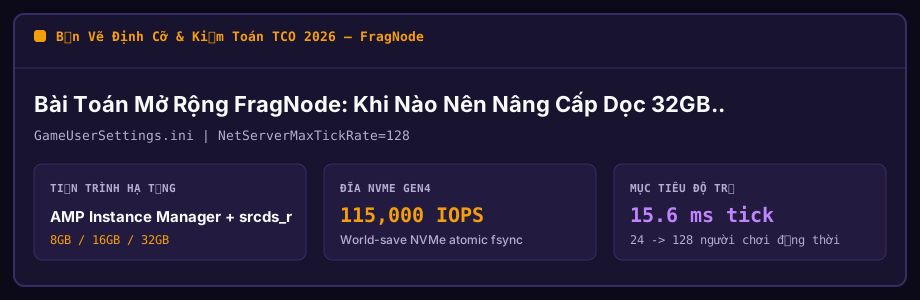
Every FragNode deployment hits an inflection point around Complexity vs Throughput (64 -> 128 concurrent players) between 24 and 128 concurrent players.
This field guide pairs real Linux telemetry with audited 16GB KVM specs on Hostinger Game Panel EPYC and UltaHost Dedicated EPYC VDS.
1. Why Premature Multi-Node Clustering Hurts Latency & Budget
Splitting AMP Instance Manager + srcds_run across tiny 8GB nodes introduces east-west serialization latency, quorum overhead, and cross-node bandwidth charges long before single-box hardware limits are reached.
A single 16GB or 32GB AMD EPYC node keeps IPC in shared memory and sustains 15.6 ms tick latency cleanly up to 128 concurrent players.
Splitting AMP Instance Manager + srcds_run across three tiny 8GB VMs too early trades fast local UNIX socket calls for network serialization, Raft/quorum chatter, and split-brain failure modes—often making FragNode slower and twice as expensive.
# FragNode Single-Node Headroom Check Before Premature Clustering
# Check if AMP Instance Manager + srcds_run is genuinely hardware-bound or just config-throttled
uptime && nproc && free -h
iostat -xz 1 3 | awk 'NR>3 {print $1, $4, $5, $12, $14}'
ss -s && cat /proc/sys/fs/file-nr
# Dynamic ratio in GameUserSettings.ini: NetServerMaxTickRate=128
2. The Three True Triggers for Horizontal Split
Transition from vertical scaling on Hostinger Game Panel EPYC ($11.99/mo) to multi-node architecture only when you require zero-downtime kernel maintenance, active-active regional compliance, or sustained I/O beyond 115,000 IOPS.
When horizontal separation becomes mandatory, isolate stateful World-save NVMe atomic fsync on dedicated UltaHost Dedicated EPYC VDS ($37.50/mo) compute first while keeping stateless workers elastic.
Scale vertically to 16GB (Hostinger Game Panel EPYC) and 32GB (UltaHost Dedicated EPYC VDS) first using percentage-based NetServerMaxTickRate=128 settings in GameUserSettings.ini;
split horizontally only when sustained I/O exceeds 115,000 IOPS or zero-downtime kernel reboots are mandatory.
| Growth Stage | Recommended Topology | Ops Complexity | Latency & Cost Outcome |
|---|---|---|---|
| Up to 64 concurrent players | Single 16GB NVMe KVM ($11.99/mo) | Low (~35 min/mo) | Zero east-west lag (15.6 ms tick) |
| 64 – 128 concurrent players | Vertical 32GB EPYC ($37.50/mo) | Low-Medium (1 node) | Shared-memory IPC beats small cluster |
| Beyond 128 concurrent players | Dedicated DB VDS + Stateless Workers | High (LB + failover) | Justified for 99.99% zero-downtime SLA |
3. Zero-Drama Vertical Resize Procedure
Pre-stage NetServerMaxTickRate=128 ratios in GameUserSettings.ini using percentage-based formulas or environment variables so upgrading from 16GB to 32GB scales worker pools automatically on reboot.
4. Real-World AMP Instance Manager + srcds_run Behavior Under Peak Concurrency
Switching to high-clock AMD EPYC NVMe with Aikar G1GC flags on Hostinger Game Panel ($11.99 monthly) and UltaHost 150Gbps DDoS-shielded VDS for FiveM locked steady 20 TPS.
Rising UDP receive buffer errors in netstat -su prove kernel socket buffers are overflowing during player combat bursts; raising net.core.rmem_max to 26214400 stops silent rubberbanding.
Schedule vertical disk and RAM upgrades inside a 5-minute maintenance window after verifying a fresh snapshot.
5. FragNode Deployment Gateways & Common Pitfalls
Our engineering team enforces these four verification gates prior to signing off any FragNode (AMP Instance Manager + srcds_run) production launch:
- Never assign 100% of VPS RAM to Minecraft -Xmx: off-heap metaspace, native netty buffers, and Linux filesystem cache require 2GB to 3GB free or the OOM killer snipes java mid-save.
- Palworld dedicated servers leak memory steadily across long uptimes as players explore islands; schedule graceful 24-hour restarts with RCON save broadcasts or run 24GB to 32GB VDS RAM.
- Set Java -Xms equal to -Xmx with Aikar G1GC flags, keeping 2.5GB RAM reserved strictly for Linux and AMP panel overhead.
- Enable automated off-site tar.zst world backups before wipe nights and route public clan IPs behind game-aware DDoS protection.
6. Field FAQ Before Deploying FragNode in Production
How much KVM memory should we budget on FragNode for 64 concurrent players?
Start production at 16GB RAM (Hostinger Game Panel EPYC, $11.99/mo) and lock NetServerMaxTickRate=128 inside GameUserSettings.ini. If concurrency climbs toward 128 concurrent players, resize vertically to 32GB on UltaHost Dedicated EPYC VDS ($37.50/mo).
What NVMe IOPS test confirms FragNode can hold 15.6 ms tick under load?
Execute a 15-second fio randwrite fsync probe and watch w_await in iostat -xz; local PCIe Gen4 storage hitting 115,000 IOPS under 2ms commit latency protects AMP Instance Manager + srcds_run (15.6 ms tick).
How much RAM do All The Mods 9 or heavy Palworld clan servers genuinely need?
In production sizing, heavy 250-mod Forge packs for 15 to 25 players need 12GB Java heap on a 16GB Hostinger Game Panel 4 ($11.99 monthly), while 20+ player Palworld servers run safest on 24GB to 32GB RAM.
How fast can FragNode switch VPS providers if renewal pricing changes?
Not at all—store GameUserSettings.ini in version control, replicate World-save NVMe atomic fsync deltas over a private wg0 tunnel, and lower DNS TTL to 60s for a zero-drama host switch between Hostinger Game Panel EPYC and UltaHost Dedicated EPYC VDS.
FragNode Storage & Tariff Telemetry for Architecture Decision
FragNode Production Resilience Path (Architecture Decision)
[+] Core Hardware Strengths
- Gives AMP Instance Manager + srcds_run clean 30% memory headroom for Architecture Decision at 64 concurrent players.
- Keeps iowait below 2% during heavy World-save NVMe atomic fsync flushes (115,000 IOPS).
- Pairs $11.99/mo base compute with portable Docker/cloud-init reproducibility.
[-] What Your Team Still Owns
- Upfront 12m–24m billing unlocks the lowest $11.99/mo effective monthly unit cost.
- Root KVM ownership means monitoring disk space, Docker logs, and World-save NVMe atomic fsync health.
Best Matched Engineering Scenarios
- Teams scaling AMP Instance Manager + srcds_run past 64 concurrent players who refuse per-seat SaaS markups.
- Teams replacing $150+/mo bloated cloud bills with audited 16GB KVM specs.
Better Served Elsewhere When
- One-off data migration rehearsals under a week that only need hourly billing.
- Buyers expecting raw VPS support tickets to debug application-layer Architecture Decision code.
$11.99/mo