FragNode SaaS Exit Calculator: Reclaiming 70%–85% Infrastructure Margin
Hostinger Game Panel EPYC
Audited 16GB DDR5 fit for SaaS Exit Calculator ($11.99/mo)
UltaHost Dedicated EPYC VDS
High-clock compute targeting 15.6 ms tick tail SLA
InterServer Price-Lock KVM & ZFS
Zero-hike monthly rate across 64 concurrent players
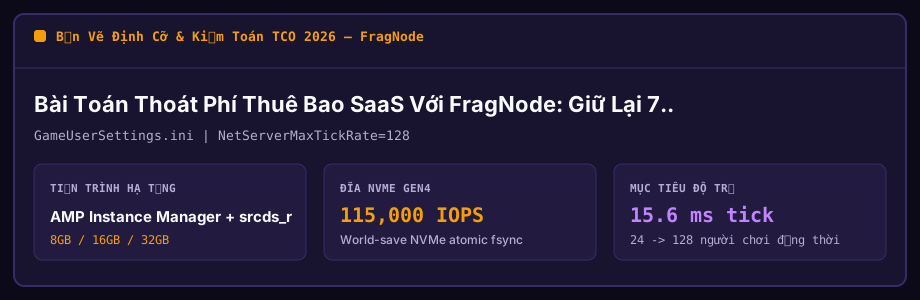
When FragNode workloads push World-save NVMe atomic fsync toward 64 concurrent players, stock Linux defaults fail fast.
Use this verified Annual Savings (16GB Self-Hosted vs Managed Cloud) playbook to lock NetServerMaxTickRate=128 in GameUserSettings.ini on Hostinger Game Panel EPYC or UltaHost Dedicated EPYC VDS.
1. Where Per-Seat & Usage Metering Breaks Team Budgets
Per-seat SaaS tiers charge steep per-seat or per-event overage tiers the moment usage crosses 24 concurrent players. Annual SaaS invoices routinely exceed $2,400–$6,000 for mid-sized teams.
Running AMP Instance Manager + srcds_run on a dedicated 16GB KVM node (Hostinger Game Panel EPYC at $11.99/mo) replaces escalating seat fees with a flat, forecastable recurring asset.
Usage-metered SaaS pricing punishes your team the exact week your product gains traction, charging 10x markups on commodity RAM and NVMe.
Moving AMP Instance Manager + srcds_run onto a declarative 16GB KVM instance caps compute spend while removing artificial rate limits.
# FragNode Zero-Downtime SaaS Exit & Cutover Parity Check
# Pre-cutover DNS TTL staging & health verification for AMP Instance Manager + srcds_run
dig +noall +answer fragnode.internal.lan
curl -fsSL -w 'HTTP %{http_code} | TTFB %{time_starttransfer}s\n' -o /dev/null https://127.0.0.1/healthz
# Validate GameUserSettings.ini (NetServerMaxTickRate=128) under parallel shadow load
2. Operational Overhead Reality: 45 Minutes Per Month
With declarative container images, GameUserSettings.ini version control, and unattended security patches, maintaining FragNode workloads takes under one hour per month.
Full root ownership also unlocks custom NetServerMaxTickRate=128 tuning, private VPC data residency, and zero third-party rate throttling across 128 concurrent players.
Run your new Hostinger Game Panel EPYC node in shadow mode for 72 hours, verify 15.6 ms tick latency and World-save NVMe atomic fsync checksum parity, lower DNS TTL to 60s, and keep the old SaaS read-only for one billing week.
| Scale Bracket | Typical Managed SaaS | Self-Hosted KVM (Hostinger) | Net Annual Savings |
|---|---|---|---|
| Starter (24 concurrent players) | $79 – $149/mo metered | 8GB KVM (~$5.99–$8.99/mo) | $850 – $1,680/yr saved |
| Growth (64 concurrent players) | $240 – $490/mo + overages | 16GB KVM ($11.99/mo) | $2,750 – $5,700/yr saved |
| Scale (128 concurrent players) | $850 – $1,800+/mo enterprise | 32GB (UltaHost Dedicated EPYC VDS $37.50/mo) | 78%–88% margin reclaimed |
3. Phased Cutover Strategy With Zero User Downtime
Provision Hostinger Game Panel EPYC or UltaHost Dedicated EPYC VDS ($37.50/mo) alongside your legacy SaaS account, import historical data into World-save NVMe atomic fsync, and validate 15.6 ms tick latency for 72 hours.
4. Senior Engineering Notes: Avoiding Silent Annual Savings (16GB Self-Hosted vs Managed Cloud) Drift
A 45-player modded Minecraft Forge and Palworld community rented a 16-core older Xeon box expecting butter-smooth raids, yet server TPS collapsed to 9 whenever bases loaded chunks.
Inspecting running Java flags confirms whether Xms equals Xmx with Aikar G1GC MaxGCPauseMillis=50, while leave-out OS headroom prevents Linux from killing PalServer during world saves.
Flip DNS CNAME/A records during a low-traffic window once checksum parity and automated backups pass verification.
5. Zero-Surprise Rollout & Rollback Protocol
Use this field-verified FragNode pre-flight list to eliminate avoidable configuration drift around Annual Savings (16GB Self-Hosted vs Managed Cloud):
- Palworld dedicated servers leak memory steadily across long uptimes as players explore islands; schedule graceful 24-hour restarts with RCON save broadcasts or run 24GB to 32GB VDS RAM.
- Never assign 100% of VPS RAM to Minecraft -Xmx: off-heap metaspace, native netty buffers, and Linux filesystem cache require 2GB to 3GB free or the OOM killer snipes java mid-save.
- Enable automated off-site tar.zst world backups before wipe nights and route public clan IPs behind game-aware DDoS protection.
- Set Java -Xms equal to -Xmx with Aikar G1GC flags, keeping 2.5GB RAM reserved strictly for Linux and AMP panel overhead.
6. FragNode Practitioner FAQ: Annual Savings (16GB Self-Hosted vs Ma
Where is the sweet-spot RAM ceiling for FragNode (Annual Savings (16GB Self-Hosted vs Managed Cloud))?
Provision 16GB dedicated KVM memory (Hostinger Game Panel EPYC from $11.99/mo) paired with GameUserSettings.ini guardrails, and reserve 32GB on UltaHost Dedicated EPYC VDS ($37.50/mo) for heavy 128 concurrent players clusters.
Which Linux storage check exposes slow block I/O before launching FragNode?
Pair non-destructive fio 4K queue checks with noatime mount flags; any KVM host delivering 115,000 IOPS and < 2.5ms fsync keeps FragNode responsive at 15.6 ms tick.
How much RAM do All The Mods 9 or heavy Palworld clan servers genuinely need?
In production sizing, heavy 250-mod Forge packs for 15 to 25 players need 12GB Java heap on a 16GB Hostinger Game Panel 4 ($11.99 monthly), while 20+ player Palworld servers run safest on 24GB to 32GB RAM.
Does locking a 24-month KVM plan trap our FragNode architecture?
Because FragNode runs on open Ubuntu 24.04 + GameUserSettings.ini configs, syncing World-save NVMe atomic fsync via WireGuard to a new KVM instance takes minutes and needs only a 60-second DNS flip.
IOPS Headroom vs Base Cost for SaaS Exit Calculator
Packet-to-NVMe Commit Pipeline for SaaS Exit Calculator
[+] Validated Sizing Benefits
- Sizes AMP Instance Manager + srcds_run RSS cleanly for SaaS Exit Calculator with dedicated 16GB NVMe resources.
- Delivers deterministic 15.6 ms tick tail response across 115,000 IOPS local NVMe.
- Lets engineers tune kernel sysctl and GameUserSettings.ini without enterprise tier gatekeeping.
[-] Operational Caveats to Plan For
- Locking $11.99/mo on Hostinger Game Panel EPYC requires annual commitment rather than 1-month billing.
- Operators must apply NetServerMaxTickRate=128 in GameUserSettings.ini before production cutover.
Right-Sized For Workloads That
- Workloads where World-save NVMe atomic fsync throughput (115,000 IOPS) governs user UX.
- Data-sensitive apps requiring private disk residency for World-save NVMe atomic fsync.
When Hourly Cloud or Managed Fits Better
- Throwaway weekend prototypes torn down after 72 hours (use hourly UltaHost compute).
- Organizations without a designated owner for AMP Instance Manager + srcds_run alerts and backup checks.
$11.99/mo