FragNode vCPU Sizing Guide: Eliminating Hypervisor CPU Steal Spikes
Hostinger Game Panel EPYC
Best 3-year margin on AMP Instance Manager (16GB)
UltaHost Dedicated EPYC VDS
Elastic regional node (115,000 IOPS local NVMe)
InterServer Price-Lock KVM & ZFS
Predictable tariff cap for FragNode backups
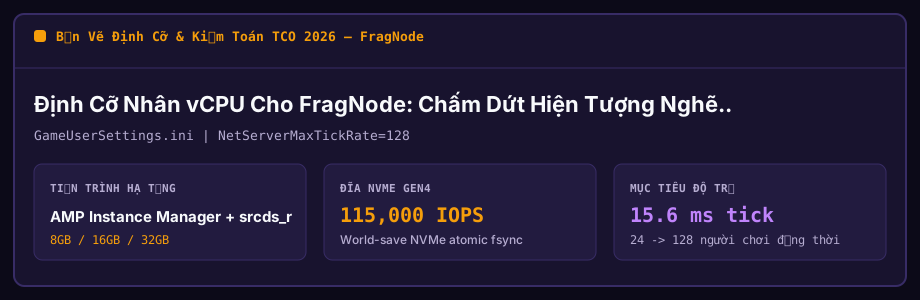
In production FragNode audits, Hypervisor %st Steal Time (< 1.5% Threshold) is the dividing line between calm 15.6 ms tick delivery and 2 AM outage pages.
Here is how we size AMP Instance Manager + srcds_run, tune GameUserSettings.ini, and benchmark Hostinger Game Panel EPYC ($11.99/mo) against UltaHost Dedicated EPYC VDS ($37.50/mo).
1. Diagnosing %st CPU Steal Degradation in AMP Instance Manager + srcds_run
Oversold cloud hosts time-slice physical cores aggressively, causing vmstat %st steal readings above 12%. For AMP Instance Manager + srcds_run, hypervisor scheduling delays stretch mutex locks and ruin 15.6 ms tick targets.
Modern AMD EPYC Gen4 KVM nodes maintain < 1.2% steal under normal 64 concurrent players concurrency when paired with NetServerMaxTickRate=128.
Two 4-vCPU servers priced identically can differ by 3x in real throughput if one host oversells old Xeon threads at 14% CPU steal.
Whenever hypervisor descheduling pauses a thread holding an internal lock in AMP Instance Manager + srcds_run, every queued request behind it stalls.
# FragNode Hypervisor %st Steal Telemetry & Worker Thread Alignment
# Sample hypervisor %st steal & per-core softirq load during peak traffic
vmstat 1 10
mpstat -P ALL 2 5
lscpu | grep -E 'Model name|CPU\(s\)|Thread|NUMA'
# Match worker count in GameUserSettings.ini (NetServerMaxTickRate=128) to nproc
2. Core Count Matrix for 24 to 128 concurrent players
2 vCPU + 8GB RAM comfortably serves 24 concurrent players. Upgrading to 4 vCPU + 16GB RAM (Hostinger Game Panel EPYC at $11.99/mo) prevents worker queue buildup during peak hours.
Sustained > 75% CPU utilization across 128 concurrent players warrants dedicated physical threads on UltaHost Dedicated EPYC VDS ($37.50/mo) with 32GB RAM.
Cap worker processes in GameUserSettings.ini (NetServerMaxTickRate=128) strictly to physical vCPU count (`nproc`) and verify < 1.5% steal under weekday peak load on Hostinger Game Panel EPYC or UltaHost Dedicated EPYC VDS.
| Observed %st Steal | CPU Load Profile | Latency Impact | Hardware Action |
|---|---|---|---|
| 0.0% – 1.5% steal | < 60% avg (24–64 concurrent players) | Holds 15.6 ms tick cleanly | Stay on Hostinger Game Panel EPYC ($11.99/mo) |
| 2.0% – 5.5% steal | Sustained 70% weekday bursts | p99 jitter +35%–60% | Step up vCPU tier or High-Freq UltaHost |
| > 6.0% steal | Continuous > 80% (128 concurrent players) | Mutex & queue stalls | Move to dedicated EPYC VDS (32GB) |
3. Thread Pinning & IRQ Balance Best Practices
Align worker counts inside GameUserSettings.ini strictly to physical vCPU count rather than over-spawning threads that waste L3 cache locality through context switching.
4. Production-Grade Guardrails Around GameUserSettings.ini
Game main loops are single-thread bound: 2.2GHz shared cores plus default Java Stop-The-World garbage collection paused ticks for 420ms while UDP query floods spiked packet loss.
Rising UDP receive buffer errors in netstat -su prove kernel socket buffers are overflowing during player combat bursts; raising net.core.rmem_max to 26214400 stops silent rubberbanding.
Enable irqbalance on multi-core KVM instances so high-rate network interrupts distribute evenly across all available vCPUs.
5. Operational Hardening & Migration Checklist (15.6 ms tick)
Our engineering team enforces these four verification gates prior to signing off any FragNode (AMP Instance Manager + srcds_run) production launch:
- Never assign 100% of VPS RAM to Minecraft -Xmx: off-heap metaspace, native netty buffers, and Linux filesystem cache require 2GB to 3GB free or the OOM killer snipes java mid-save.
- Palworld dedicated servers leak memory steadily across long uptimes as players explore islands; schedule graceful 24-hour restarts with RCON save broadcasts or run 24GB to 32GB VDS RAM.
- Set Java -Xms equal to -Xmx with Aikar G1GC flags, keeping 2.5GB RAM reserved strictly for Linux and AMP panel overhead.
- Enable automated off-site tar.zst world backups before wipe nights and route public clan IPs behind game-aware DDoS protection.
6. Technical Buyer Questions for FragNode Operators
How much KVM memory should we budget on FragNode for 64 concurrent players?
Start production at 16GB RAM (Hostinger Game Panel EPYC, $11.99/mo) and lock NetServerMaxTickRate=128 inside GameUserSettings.ini. If concurrency climbs toward 128 concurrent players, resize vertically to 32GB on UltaHost Dedicated EPYC VDS ($37.50/mo).
What NVMe IOPS test confirms FragNode can hold 15.6 ms tick under load?
Execute a 15-second fio randwrite fsync probe and watch w_await in iostat -xz; local PCIe Gen4 storage hitting 115,000 IOPS under 2ms commit latency protects AMP Instance Manager + srcds_run (15.6 ms tick).
How much RAM do All The Mods 9 or heavy Palworld clan servers genuinely need?
In production sizing, heavy 250-mod Forge packs for 15 to 25 players need 12GB Java heap on a 16GB Hostinger Game Panel 4 ($11.99 monthly), while 20+ player Palworld servers run safest on 24GB to 32GB RAM.
How fast can FragNode switch VPS providers if renewal pricing changes?
Not at all—store GameUserSettings.ini in version control, replicate World-save NVMe atomic fsync deltas over a private wg0 tunnel, and lower DNS TTL to 60s for a zero-drama host switch between Hostinger Game Panel EPYC and UltaHost Dedicated EPYC VDS.
AMP Instance Manager + s Host Comparison: vCPU Sizing Guide
System Architecture: AMP Instance Manager + ZSTD Backup
[+] Key Engineering Advantages
- Isolates 16GB RAM so AMP Instance Manager + srcds_run runs vCPU Sizing Guide without swap thrashing.
- Maintains shallow NVMe queue depth for vCPU Sizing Guide even during snapshot runs (15.6 ms tick).
- Preserves 75%+ gross margin when scaling FragNode from 64 to 128 concurrent players.
[-] Billing & Maintenance Realities
- Standard renewal tariffs on Hostinger Game Panel EPYC step up after term 1 unless budgeted over 36 months.
- Requires 30–45 minutes per month for patch verification and World-save NVMe atomic fsync backup checks.
Ideal Production Buyer Profile
- Founders migrating 24–128 concurrent players off throttled shared cloud instances.
- Technical owners comfortable running a 5-minute monthly backup restore verification.
Hold Off Provisioning This Tier If
- Short load-testing spikes where pay-per-hour UltaHost Dedicated EPYC VDS avoids long-term billing.
- Teams skipping offsite backups who would risk single-disk data loss on raw VMs.
$11.99/mo