FragNode Disaster Recovery Blueprint: Crash-Consistent Backups & Fast RTO
Hostinger Game Panel EPYC
Disaster Recovery Blueprint sweet spot (16GB / 115,000 IOPS) — Game Panel 4 (16GB DDR5 + AMP Panel)
UltaHost Dedicated EPYC VDS
Low-RTT compute for AMP Instance Manager + (15.6 ms tick)
InterServer Price-Lock KVM & ZFS
Flat-rate backup/steady option (24–64 concurrent players)
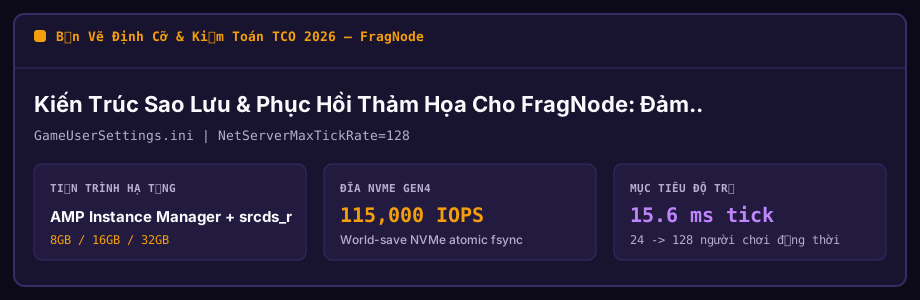
Before migrating or scaling AMP Instance Manager + srcds_run on FragNode, benchmark Recovery Point / Time Objective (15m RPO / 8m RTO) under realistic peak concurrency rather than idle staging load.
Follow the sizing matrix and cutover checklist below to hold 15.6 ms tick reliably.
1. Why Naive File Copies Corrupt Live World-save NVMe atomic fsync State
Running plain tar or rsync against live AMP Instance Manager + srcds_run directories captures torn pages mid-flush. Restoring an inconsistent archive leaves World-save NVMe atomic fsync unmountable during an outage.
Always trigger atomic application checkpoints or LVM/ZFS snapshots alongside GameUserSettings.ini backups before streaming encrypted chunks offsite.
Copying live World-save NVMe atomic fsync files with plain rsync during active writes captures half-flushed blocks that refuse to mount when disaster strikes.
A backup strategy on FragNode only counts after an automated restore boots AMP Instance Manager + srcds_run cleanly on a separate host.
# FragNode Crash-Consistent Snapshot & Encrypted Offsite Restic Flow
# Atomic pre-backup flush + ZSTD encrypted offsite archive for AMP Instance Manager + srcds_run
sync && restic -r s3:https://s3-backup-vault/fragnode backup \
  GameUserSettings.ini /var/lib \
  --compression max --tag "FragNode-15m-rpo"
restic -r s3:https://s3-backup-vault/fragnode forget --keep-hourly 24 --keep-daily 14 --prune
2. Sizing Disk Headroom for Deduplicated Retention Windows
Maintain 30% free NVMe capacity on your 16GB Hostinger Game Panel EPYC ($11.99/mo) node so local staging snapshots never collide with active 64 concurrent players writes.
Pair weekly host-level snapshots with 15-minute incremental ZSTD archives to an independent secondary region (UltaHost Dedicated EPYC VDS at $37.50/mo) for 3-2-1 compliance.
Keep 30% free NVMe headroom on Hostinger Game Panel EPYC (16GB at $11.99/mo) for local snapshot copy-on-write staging, encrypt archives with AES-256 keys stored outside the VPS, and drill restores monthly.
| Protection Layer | Cadence / RPO | Storage Target | Restore Speed (RTO) |
|---|---|---|---|
| Incremental WAL / State Sync | Every 15 minutes | Offsite S3 / Object Vault | < 8 minutes onto fresh KVM |
| Deduplicated Restic ZSTD | Hourly + Nightly | Secondary region (UltaHost) | 10 – 14 minutes verified |
| Full KVM Disk Snapshot | Weekly + Pre-Upgrade | Hostinger panel slot | 4 minutes whole-VM rollback |
3. Automated Monthly Restore Verification Protocol
Backups you never restore rot silently when encryption keys or schema versions drift. Spin up an ephemeral 8GB verification instance monthly to boot AMP Instance Manager + srcds_run from cold storage.
4. Real-World AMP Instance Manager + srcds_run Behavior Under Peak Concurrency
Switching to high-clock AMD EPYC NVMe with Aikar G1GC flags on Hostinger Game Panel ($11.99 monthly) and UltaHost 150Gbps DDoS-shielded VDS for FiveM locked steady 20 TPS.
Per-slot game hosting looks cheap for 8 friends, yet the moment you add 200 Forge mods or scale to 32 clan members, shared-CPU slot pricing jumps past $45 monthly without dedicated RAM.
Measure end-to-end restore duration and verify health endpoints return HTTP 200 within your 8-minute RTO target.
5. FragNode Deployment Gateways & Common Pitfalls
Do not flip DNS records until your FragNode host passes each GameUserSettings.ini and World-save NVMe atomic fsync check below:
- Many Xeon core-count bargains run at 2.1GHz base clock, starving single-threaded Minecraft 50ms tick budgets and CS2 sub-tick frame deadlines even while 14 cores sit idle.
- Standard web firewalls cannot stop Layer-7 UDP A2S_INFO or RakNet amplification floods; public FiveM and Rust communities need inline game-aware DDoS scrubbing in Singapore or Frankfurt.
- Tune sysctl net.core.rmem_max=26214400 and wmem_max=26214400 on Linux game hosts to eliminate UDP micro-stutter.
- Pre-generate Minecraft world borders with Chunky during off-hours so weekend exploration reads cached NVMe files instead of pegging CPU.
6. Engineering Q&A: RAM, NVMe & 36-Month Host Selection
Which Hostinger or UltaHost spec fits AMP Instance Manager + srcds_run at 64 concurrent players?
For 64 concurrent players, 16GB NVMe compute on Hostinger Game Panel EPYC ($11.99/mo) gives AMP Instance Manager + srcds_run clean 30% headroom; scale to 32GB (UltaHost Dedicated EPYC VDS at $37.50/mo) ahead of 128 concurrent players.
How can our sysadmins check disk queue health around World-save NVMe atomic fsync?
Audit iostat %util and 4K synchronous write speed prior to DNS cutover—sustaining 115,000 IOPS on local NVMe prevents World-save NVMe atomic fsync stalls and locks in 15.6 ms tick.
When should a FiveM or Rust community step up from Game KVM to UltaHost VDS?
Once public servers attract rival L7 UDP floods or pass 40 concurrent players with heavy OneSync scripts, we recommend UltaHost VDS 32GB ($37.50 monthly) for zero-steal physical RAM and 150Gbps+ DDoS filtering.
What keeps World-save NVMe atomic fsync portable between Hostinger and UltaHost?
Standard Linux KVM portability means AMP Instance Manager + srcds_run, GameUserSettings.ini, and ZSTD snapshots of World-save NVMe atomic fsync restore onto UltaHost Dedicated EPYC VDS or Hostinger Game Panel EPYC in under 10 minutes without vendor lock-in.
Disaster Recovery Blueprint: NVMe 4K IOPS vs Monthly Rate (115,000 IOPS)
FragNode Isolation Pipeline for Disaster Recovery Blueprint (16GB)
[+] Why This Spec Works for Disaster Recovery Blueprin
- Keeps Disaster Recovery Blueprint workloads stable inside 16GB DDR5 across 64 concurrent players.
- Local Gen4 NVMe queues absorb World-save NVMe atomic fsync commits at 115,000 IOPS (15.6 ms tick).
- Cuts 36-month Disaster Recovery Blueprint hosting spend by 70%–85% compared against metered SaaS tiers.
[-] Pre-Cutover Constraints
- Rolling monthly checkout costs more per month than Hostinger Game Panel EPYC multi-year partner terms.
- Your team owns GameUserSettings.ini tuning (NetServerMaxTickRate=128) and automated offsite backups.
Deploy This Spec for Disaster Recovery Bluepr If
- Engineers sizing Disaster Recovery Blueprint for 24–128 concurrent players with predictable TCO.
- Builders needing root SSH to enforce NetServerMaxTickRate=128 in GameUserSettings.ini.
Non-Ideal Scenarios (Use Hourly VM)
- Ephemeral staging branches destroyed nightly via API — spin up hourly UltaHost VMs.
- Non-technical teams unwilling to touch GameUserSettings.ini or basic Linux CLI tools.
$11.99/mo